For buy-side diligence firms
Every scope checks who supplies the brand. None check who sells it.
- 👉 The downstream channel your scope doesn't reach
- 👉 A measurement, not a judgement — the transaction call stays your client's
- 👉 Reproduce it inside your deliverable; the licence is included
$299 per brand, any catalog size
Reproduce with attribution · Amazon US
Emailed in under 10 minutes
No subscription, no trade tier • 7-day refund†

Depth on the channel, and where the brand actually stands
A target's inbound supply chain is well covered — every firm publishing an FBA scope checks suppliers, lead times, COGS and trademark ownership. The outbound side is not. A seller can tell your client he is the only seller; that is his word, in a document he prepared, and there has been nowhere else to go.
Two things come back. Depth — the whole catalogue the brand sells under, where its revenue actually concentrates, and which accounts hold the listings. Position — where it ranks in each niche the revenue depends on, and which rivals sit above it in more than one. Both measured from Amazon's own data, with no access to the target's Seller Central and no cooperation from the seller.
What the report covers
Every ASIN under the brand, grouped into the products a shopper actually sees. Where revenue concentrates and how far the tail runs. Which accounts carry the listings, how deeply, and who wins the buy box — reported as a population, never as a subtraction.
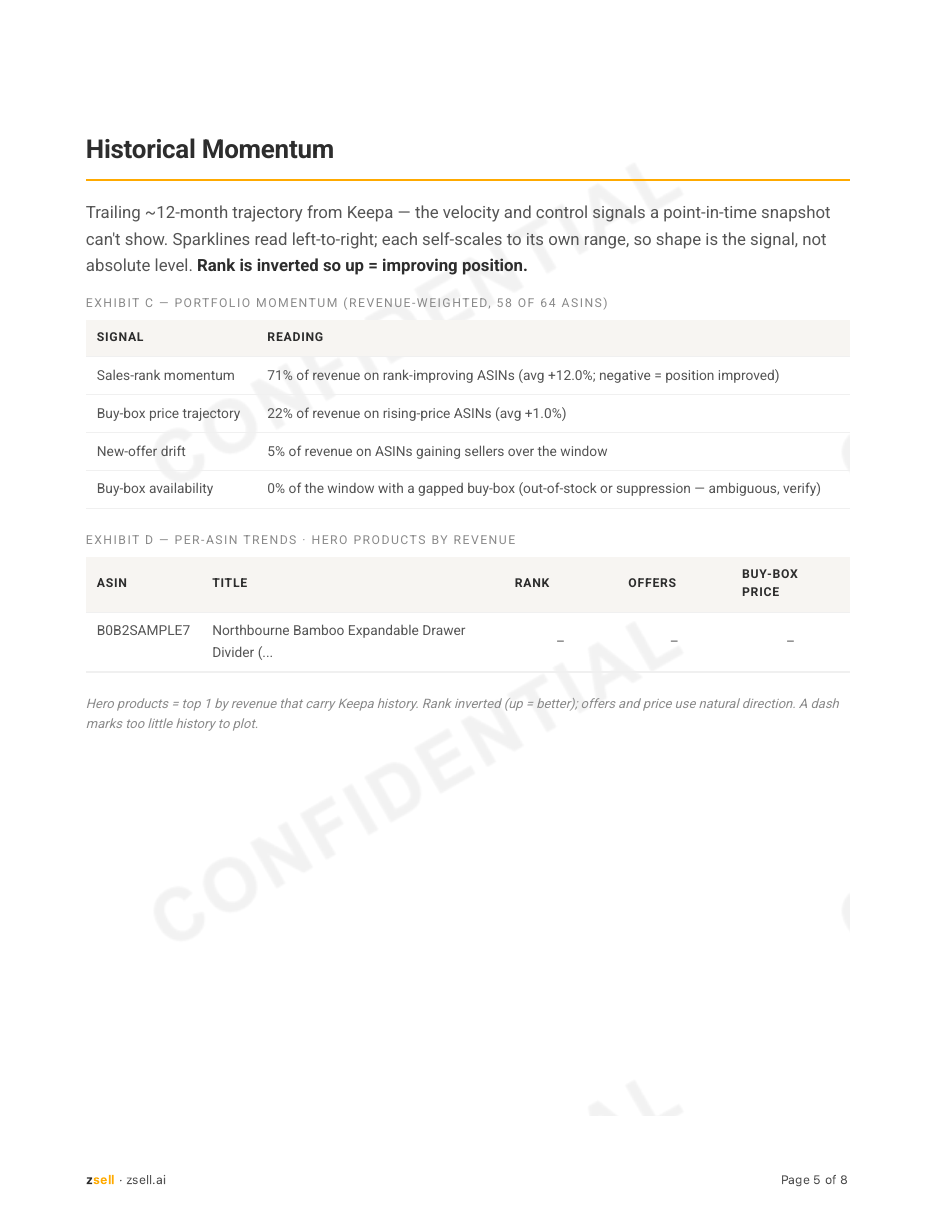
The brand's rank in the Amazon category each listing is filed under, the brands ahead of it, and how concentrated each niche is against its own arithmetic floor. Rivals that outrank it in more than one niche are separated out, because a single competitor ahead portfolio-wide is a different problem from a different incumbent in each corner.
Each exposure carries the horizon it could be put right on — weeks, a year, or not by any operator. Every figure carries the population it was measured over. The report states no view on the transaction, which is your client's call and yours.
Inside the report
The same print-grade PDF an acquirer receives, built from live Amazon data at run time.
What the report reads like
Two anonymised reports from real evaluations. Open them before you quote us to a client.
- Catalog footprint: Three listings resolving to three products, all in one niche — two carry effectively all the measured revenue.
- Control signals: Clean registry posture, no hijackers. One listing holds no buy box at all: Amazon is not letting it sell, and the cause is not visible from outside.
- Niche dependence: Total. One niche carries 100% of measured revenue, with no second line to absorb a category shift.
- What is fixable: Weeks for the suppressed listing — diagnosable from inside the account. A year for a second niche, because that is a build. Nothing here is beyond an operator.
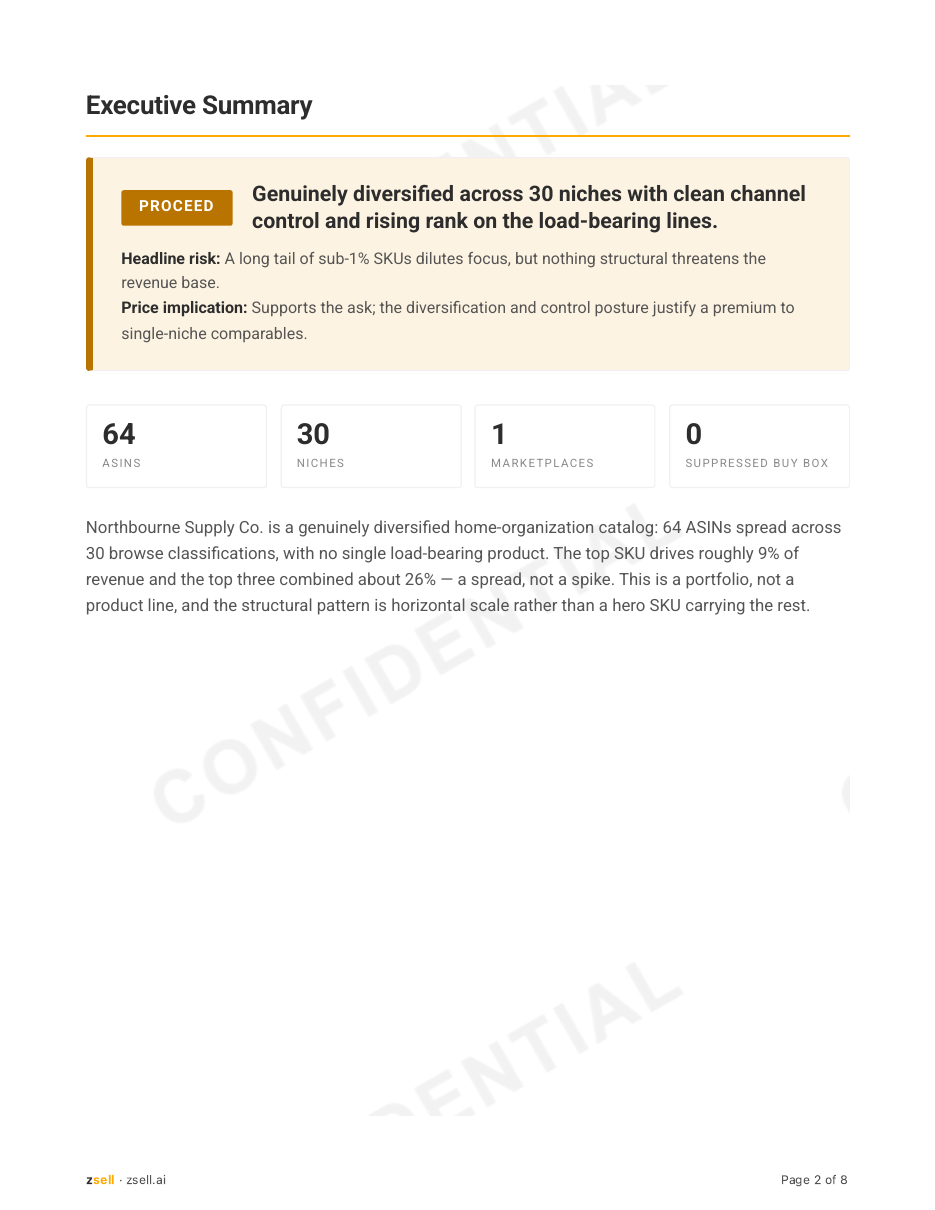
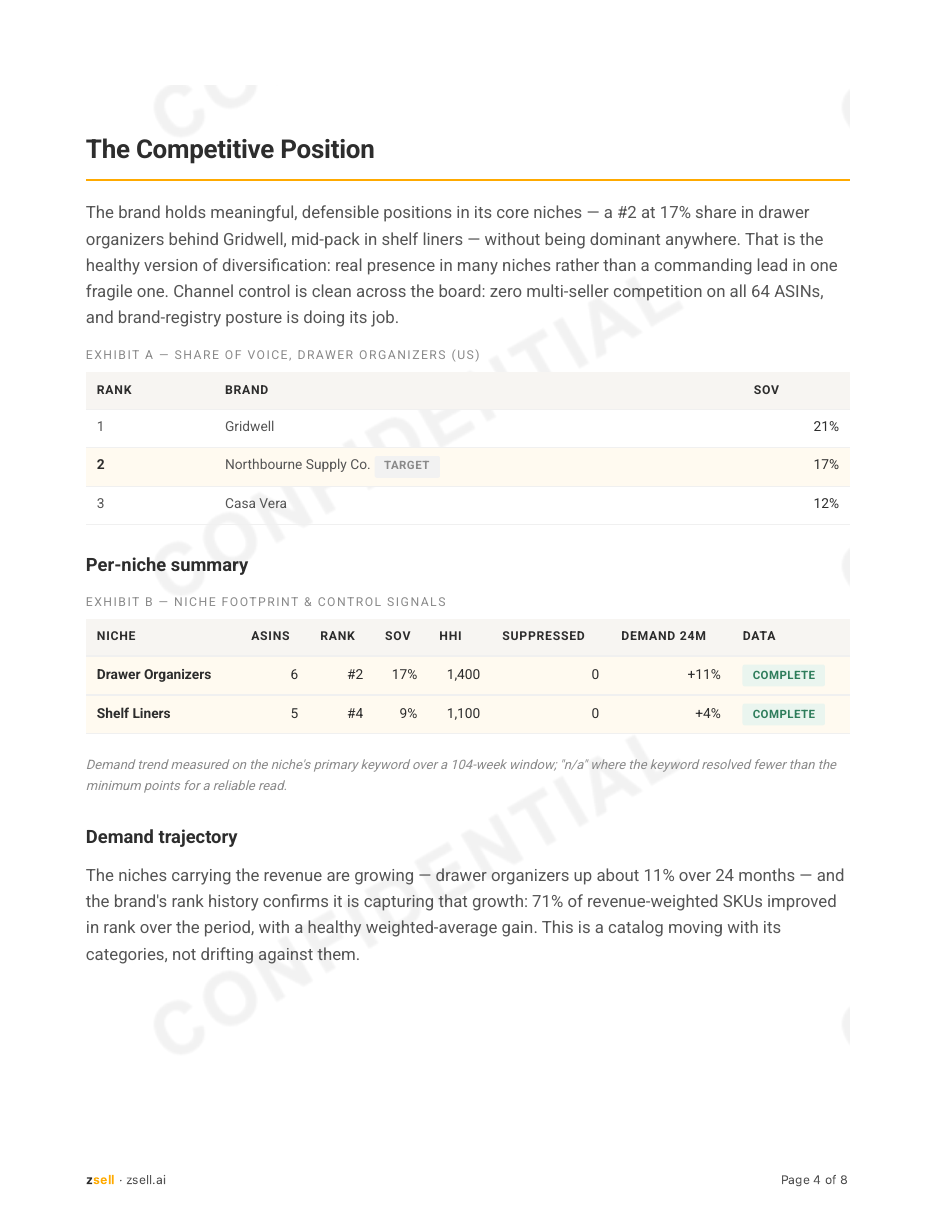
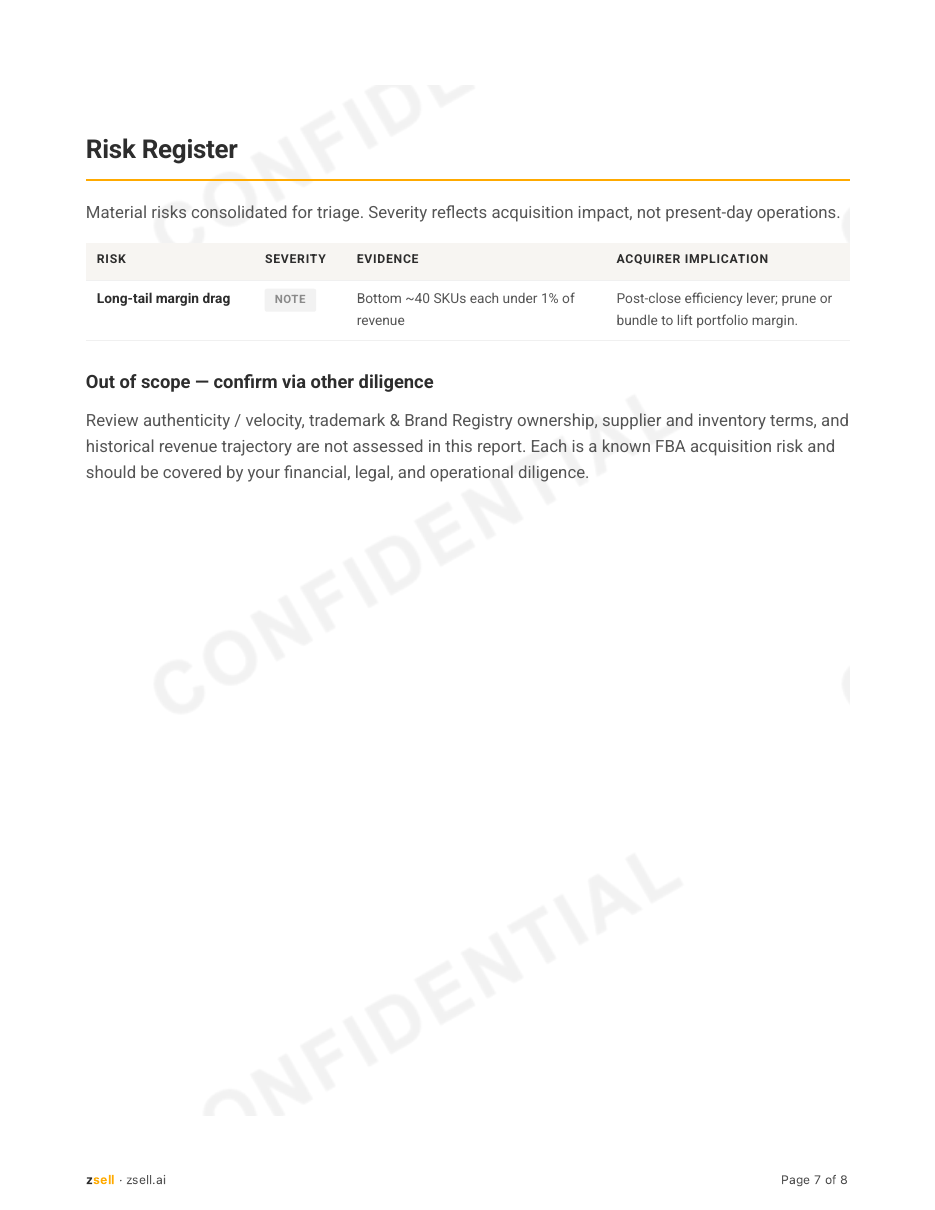
- Catalog footprint: 64 listings resolving to 64 distinct products across 30 browse classifications — a portfolio, not a product line.
- Concentration risk: Top product 9% of measured revenue, top three 26%. Amazon-published and measured per product, so variant double-counting cannot inflate it.
- Control signals: Zero multi-seller competition across all 64 listings, and no suppressed buy boxes anywhere.
- What is fixable: Nothing is gated — no quick revenue behind a fixable fault. The one soft spot is a long tail of roughly 40 sub-1% products, a catalog cycle of work.
Identifying detail anonymised. Both were produced by the pipeline that will run your client's brand.
How it works
Stripe Checkout. No account creation, no onboarding call.
Brand name as it appears on Amazon. Nothing from the seller.
Live Amazon data. 5–10 minutes, not a five-day turnaround.
Print-grade PDF and a permanent link your client can open and re-run.
Pricing
One price per brand, whatever the catalogue holds. We priced by catalogue size until we measured it properly, and size predicts neither the work nor what the answer is worth — a five-listing brand can raise harder questions than a five-hundred-listing one.
One-off purchase, no subscription and no retainer. There is no separate trade rate: this is the same document at the same price an acquirer pays, with a licence attached — a professional discount would have to come off that same price, which is a discount rather than a wholesale tier. A volume arrangement is a different conversation and we are happy to have it. Amazon US for now; other marketplaces are quoted individually.
Who this is for
A deal assembled from independent specialist streams rather than one integrated team. You already buy components; this is one more, on a question your current scope leaves open.
You sell a scored pre-LOI report with named dimensions. This fills a dimension you cannot fill in-house, without building the measurement or the data relationship behind it.
The data spine of a four-figure brand-acquisition engagement, produced in ten minutes rather than a week, with an artefact your client can verify themselves.
Where the report may not be prepared by or for the borrower or seller, a measurement commissioned by you and attributed to an outside party is the shape the requirement asks for.
Frequently asked
Can we reproduce this inside our own report?
Can we white-label it?
Who carries the liability for the finding?
How does this sit against a quality-of-earnings report?
Do you need the seller's cooperation, or Seller Central access?
What if our client re-runs it and sees a different number?
Does a bigger catalog cost more?
Do you offer a volume rate?
What this is NOT
A report you put your name beside has to be honest about its edges, or it cannot be relied on inside your scope.
- ✖ Not a quality-of-earnings report — It tests the channel, not the earnings. It does not verify a P&L, reconcile settlements, or test add-backs.
- ✖ Not a conclusion on the transaction — No valuation, no multiple, no recommendation. The structural picture and the risks; the decision stays with you and your client.
- ✖ Not white-labelled — Findings reproduced from it carry our name. That is the condition of the licence and the source of the report's value downstream.
- ✖ Not the whole channel picture — Amazon only. Off-Amazon revenue, supplier contracts, financials and legal are outside what this measures, and the report says so rather than letting you assume the gap is covered.
Built by Werner Heigl
PhD geophysicist applying signal-processing methodology to e-commerce intelligence data. Vision evolved from real FBA brand audits Werner ran as an independent consultant.
One report. One brand. $299.
Reproduction licence included. Stripe Checkout, no account. Delivered in under 10 minutes.
🔒 7-day refund — full refund if the report doesn't materially inform the engagement.
† 7-day refund. If the report fails to materially inform your engagement — it doesn't run, returns no usable footprint, or can't evaluate the marketplace you specified — email us within 7 days for a full refund. Refunds aren't offered because a reading came back clean: a brand carried by one account is a finding your client needs, and the report is a decision document either way.